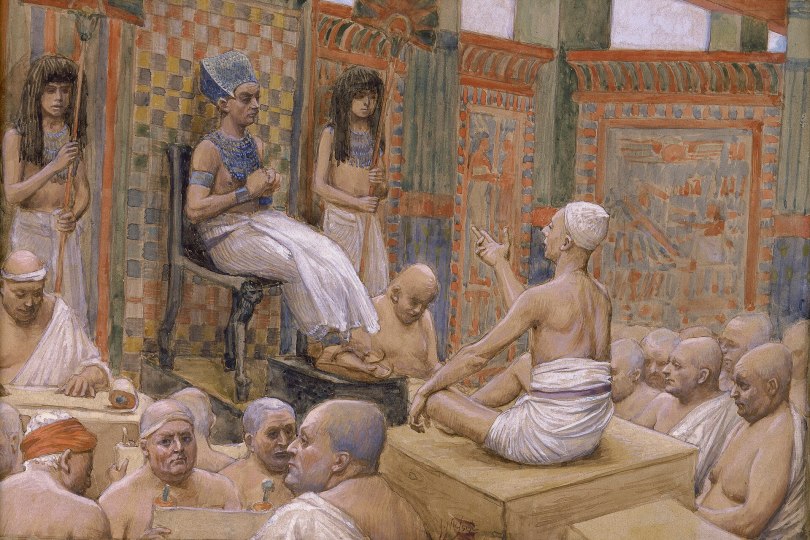
Joseph Interprets Pharaoh's Dream, c. 1896-1902, by James Jacques Joseph Tissot. Public Domain.

Coincidences for Starters

Suspicious van

Now comes a selection of coincidences that occurred during my psychosis following the discovery of Natural Money in 2008. These incidents made me think there was more afoot than just me having a psychotic episode, and that God was pulling pranks on me. There is a link between Natural Money and the Bible. Ancient Egypt used money backed by grain stored in the state’s granaries. It had a storage fee like Natural Money. The biblical story of Joseph in Genesis recounts how these granaries came into existence, allegedly that is, for it is unlikely the truth. Only, the Bible being full of shit doesn’t mean that there is no God, or so I had just found out. Just after the discovery of Natural Money, an advertising campaign for the Dutch version of the musical Joseph and the Amazing Technicolour Dreamcoat, based on the story of Joseph in Egypt, began. There was a fuss about it in the media, including television episodes in the Autumn of 2008 to select the leading player, so the musical’s start didn’t go unnoticed, not even by me, who doesn’t care about musicals.

The Joseph story gave Natural Money a biblical connection. And it was a usury-free financial system. The Bible, and the Quran even more, oppose usury, which was very suspicious indeed, not to mention that I lived in a town called Sneek, pronounced like ‘snake’, while there was allegedly a snake in Eden. It happens that A******* lived in a suburb of Eindhoven, which means Final Gardens, while the story goes that our journey is from the Garden of Eden to our final destination, the New Eden. And as a cherry on the proverbial pie, the Dutch capital Amsterdam often gets abbreviated to Adam, making it seem that I had been caught up in A*******’s fantasy world. Think of the preparation that has gone into making this happen. Sneek is over 1,000 years old. She could be God. And that was what the psychosis suggested.

Around that same time, a shabby old van with lettering De Windroos (The Windflower) had been parked in front of our home on the other side of the road. It had never been there before and had been there for several weeks. The lettering said it belonged to a furniture company from a nearby village. There seemed to be no reason for the van to be parked there for so long, so it began to attract my attention. Then, my sister-in-law noted that De Windroos is the name of a foundation helping people with psychosis. Not that she knew. And what was happening to me was precisely that: a psychosis. So, that was a most mysterious coincidence, almost spooky even.

It made me ask myself, ‘Are there mind control devices hidden inside that van causing my condition?’ One evening, I checked it out with my son Rob, who had also become curious. We took a flashlight to peek inside. It was nearly empty. There was only a suitcase, an ordinary suitcase, so not one with flashing lights and the like. There were no signs of suspicious activity. I later found out that the furniture company was in liquidation. The lawyer next door executed the liquidation. He held the van in custody and had parked it there. Nothing was worrying about that at least.

It was early December, the time of the Dutch festival of Saint Nicholas, a tradition giving presents and prank poems, which was, together with 1 April Fool’s Day, Ingrid’s favourite time of the year, as she was quite a prankster herself, but no match for the AlmighAlmightyy Eternal Prankster who had disguised Herself as A******* this time, after having been, among others, Mary Magdalene, to prank Jesus, or so I could surmise from the evidence, or so I could surmise from the evidence. We all know what happened to Jesus, so that explained my lack of enthusiasm. So Ingrid’s being a prankster was just part of the preparation for this, it suddenly seemed. We all know what happened to Jesus, so that explained my lack of enthusiasm. So Ingrid’s being a prankster was just part of the preparation for this, it suddenly seemed. In any case, Ingrid made me a present and added a poem, which was meant as a prank. It goes like so (it rhymes in Dutch),

The van that didn’t come,
but was already there

Whose van is that?
That van in front of the door.
It’s been there for a week
and gives off a strange smell.

That weird little van
is in complete control of you.
It comes from an upholstery company from Heeg,
and that is very suspicious.

You have already felt the door handle
But the door was locked
Today, you walked around it with your son
And you discovered something… oh my God!

A suitcase!
Just a suitcase, lying in that van.
What if that thing explodes?
What a disgrace to the street.

Be prepared
and stop whining.
Put this on your head,
then nothing can happen anymore.

The Merciful Saint

A most fitting present to go by that poem would have been a tin foil hat, but it was something else I don’t recall. The poem did not accurately depict the events: the van had been there for more than a week and didn’t smell. The title refers to a song named Het Busje Komt Zo (The Van Is Coming Soon) by Höllenboer, about two drug addicts waiting for the methadone bus that didn’t show up. It is also a well-known phrase in Twente, where I came from, meaning that they will take you to the loony bin soon. That didn’t happen, for I was aware of having a psychosis, making me cautious to act on the suggestions it gave. Among others, I didn’t leave Ingrid, thinking that if A******* wanted me for Herself, She could make Her intentions clear by coming over and taking me. That didn’t happen.

Curing memory loss

In the weeks leading up to the psychosis, Ingrid had added massive doses of curcumin to our food because she feared having dementia. Curcumin is an agent found in turmeric and used in curry powders. In early 2009, the gossip magazines had a windfall when Dutch celebrity Adam Curry left his much older wife, Patricia Paay, for a woman his own age. The furious left-behind Paay filled the tabloids for years to come. Among the noteworthy incidents is Paay pressing a hot bitterball on the head of a gossip journalist and threatening him with a more serious attack involving a much larger croquette. Ingrid is nine years older than I am, while A******* is my age. His first name was Adam, and his last name was Curry. Curry powders contain curcumin. Curcumin supposedly prevents memory loss, and suddenly, after being stuffed with that agent, I ‘remembered’ being the biblical Adam. It was the psychosis, of course, but this coincidence made it all the more remarkable. Ingrid believed that the curcumin had caused my condition.

My neighbour was a real estate agent. We discussed the credit crisis and the real estate market. Then he suddenly said, ‘This is quite strange. Two weeks ago, someone asked if your house was for sale.’ There had never been any interest in my house before. And it happened during the credit crisis, which made it all the more remarkable. As the psychosis had suggested that I might have to leave home soon, selling the house made sense. Ingrid and I decided to sell if there was a high bid. We had discussed moving to a smaller home earlier, so it was not an erratic move in itself. Even a second potential buyer turned up, but no one made a bid, so we kept on living there.

After, as part of the psychosis, discovering hidden messages in pop music, I set out to buy a portable CD player to listen to my old CDs and look for more. I went to an electronics shop and asked for such a device. The man behind the counter said it was an obsolete product. MP3 and MP4 players were in vogue. Then I tried my luck at another shop. The man behind the counter looked at me, flabbergasted, and said, ‘A portable CD player? Are you serious? Someone had just ordered one. The thing arrived a few just days ago, but now that guy doesn’t want it anymore.’ Well, if that isn’t coming in handy, then what is?

A few weeks later, the CD player’s earplugs had gone into hiding in a place I couldn’t think of. After a prolonged search that involved checking the usual places, I still hadn’t found them. It could be that God was making fun of me, once again, making me think, ‘Do You want me to kneel for You?’ I knelt then and saw an MP3 player lying on the ground, along with earplugs I could use. You get the picture. God was making fun of me.

My fortieth birthday was on 26 November 2008. At breakfast, Ingrid lit several candles and said there was a Christmas atmosphere. Afterwards, she blew out the candles and said they smelled like Christmas. Ingrid had never said this on my birthday before, so it contributed to the suggestion that I was the reincarnation of Jesus. That day, the terrorist attacks in Mumbai took place. I found out days later. What happened to me occupied my mind, keeping me from paying attention to the news. It seemed like A*******’s birthday present for me. It is not up to me to criticise God. I had never thought of God being a prankster murdering a few people here and there as a token of Her love. And it seemed better not to say no to this love, as I could be next in line for culling.

That same day, I met Bobby from Romania, who was selling the Street Magazine. He consistently called me lord instead of mister. The Dutch words for lord and mister are similar, so a foreigner can easily make such a mistake. Bobby lived in a holiday cottage on a campsite named De Blauwe Lantaarn (The Blue Lantern) with his wife and two children. He invited me there. When I arrived, he was waiting for me with a blue flashlight. The Dutch word for ‘flashlight’ is ‘zak lantaarn,’ which literally means ‘pocket lantern’. Hence, he showed up with a blue lantern. Strange. I gave him some money to start a new life in Romania.

Natural Money is a reform proposal for the financial system. Someone had copied it and published it on the conspiracy website Niburu.nl. Niburu.nl featured articles about NESARA, another reform proposal for the financial system. NESARA was a cult promoted by a woman calling herself the Dove of Oneness. At the time, I surmised it could be a cover for A*******. On 6 December 2008, I signed up for the email list. In the text body of the signup email, I placed ‘xxx’, just in case the Dove of Oneness was A*******. After signing up, the site displayed the following message: ‘Please note that it will take three days to process your request.’

Three days later, I came across a billboard advertising women’s underwear featuring a woman in her underwear. Next to her was the face of a man resembling Adolf Hitler. The advertisement’s text was, ‘Don’t make up, just break up.’ That was noteworthy as I supposedly was the reincarnation of Adolf Hitler, and A******* had claimed me for Herself. Had She broken up with P*****, and did She want me to leave Ingrid? That same day, Ingrid’s golden necklace, which I once gave her, broke. Ingrid felt that was a bad omen. She saw it as a symbol of our relationship. Also, that same day, I was in the swimming pool and saw the clock reading 13:13:13, which seemed like a bad omen. Yet, a psychosis is weak evidence, making me think that A******* had to make Her intentions clearer for me to leave Ingrid.

The next week, as I was leaving the swimming pool, the door malfunctioned. More precisely, I went out, and the door opened. Then I realised I had left something inside, and the door opened again. Then I wanted to go out again, but it suddenly wouldn’t open. No one had passed that door in the meantime, so it seemed to have something to do with me, and it looked like an invisible psi-force. The door stayed closed as more people gathered at the entrance, trying to get in or out. It took about 15 to 30 minutes for an employee to resolve the issue. By then, I had started resisting the psychosis and had decided not to act upon the suggestions it gave and to wait for more evidence, which didn’t come. The NESARA newsletter was crap, not suggestive of knowledge of monetary matters, so I discontinued the subscription a few months later.

The trumpets blow

On my father’s birthday, 12 December 2008, we visited him in Nijverdal. It was the day I learned about the new hobby of my parents’ neighbours: midwinter horn-blowing. They were blowing Midwinter horns all day. They had been doing that for several years at the start of winter, but it was the first time I heard them do it. The prediction that the blowing of trumpets would herald the End of Times made it seem eerie. By then, the psychosis had receded, and the telepathic connection with A******* had vanished, but I was still open to suggestion. When hearing these same horns blowing years later, they didn’t sound like trumpets at all. So, that is what suggestions can do with you.

The interior of the Catholic Church in Sneek perfectly aligned with my taste. I had been inside at the funeral of Ingrid’s mother a few years before. It was the most beautiful interior, even better than cathedrals. Could God have done this on purpose? So, I said to Ingrid, ‘Perhaps, we should visit the Church one more time and attend a mass.’ Ingrid was fine with the proposal, so we went there on 21 December. There weren’t many people. Most were ageing, so the prospects of this parish seemed bleak. And yet, the Church interior was as I had imagined, perfectly matching my taste. So perhaps God made it especially for me, or fiddled with my taste to make me appreciate that Church’s interior.

That evening, a few days before Christmas, there was a bright star in the sky. It was Venus, but it was unusually bright, much brighter than any star I had ever seen. Now, I had never paid much attention to the stars, so that doesn’t say much. Yet, the so-called Christmas Star became a topic on a few message boards. A spiritual guru from Bilthoven, the village A******* came from, had predicted its coming, which makes it a noteworthy coincidence. The guru further claimed that a Messiah would come soon. She had claimed that several times before, and those predictions had all failed, but this time there indeed was a Christmas Star. Perhaps God tried to make me believe I am the Messiah. There were indeed signs, if you can call these events that, but there was no further evidence, so plenty of reason to remain cautious about what they meant.

Ingrid tried to rent a cottage on Ameland. After a series of miscommunications with people offering cottages, she rented a cottage named Jutter, which added some juice to the coincidence. But there were two cottages named Jutter on Ameland, and Ingrid had rented one while believing she had rented the other. Later, the owner cancelled the booking because he had sold the cottage. Ameland was the island where A******* spent her holidays with her fancy man, P***** in 1989, in 1989, who might be the son of the former presenter of a famous Dutch pop music programme.

And it runs deeper. God might have interfered with my final exams at secondary school. Despite being the worst performer in the literature explanation, I received the best grade after praying that it wouldn’t be terrible. The teacher’s name was Amelink, suggesting a link with Ameland. A******* was often busy with cryptic crosswords. These are about hidden messages, while the explanation of literature is about the hidden messages in literature.

Next to the beach at De Banjaard in Zeeland, where we usually went when we stayed there, and where my parents had gone with my sister and me before, was a hotel. They refurbished it and renamed it Amadore. As AM were the initials of A*******’s first and middle name, and Her last name began with Dor. My parents went to that particular hotel once. Amadore is a hotel chain with multiple hotels in Zeeland. Yet Amadore ran a television advertising campaign featuring the De Banjaard hotel. Strange, but true.

In December 2008, my son Rob watched an episode of SpongeBob SquarePants. In this particular episode, someone lit a fire. SpongeBob takes place underwater. And so, I told Rob that we see water burning, a Dutch saying for seeing something extraordinary or impossible. A few seconds later, a siren began to wail, and a fire engine passed.

A few days later, we made a trip to Groningen. Ingrid noticed a damaged car by the side of the road. A few moments later, the vehicle in front of us broke down. It went on and on. A total of eight cars broke down on the road or stood broken down at the side of the road. The weather wasn’t unusual, but it was noteworthy, as you hardly ever see broken cars, and definitely not more than one during a single trip of that length. Well, well, those were the days. Strange things were happening nearly every day.

Meanwhile at work

Once, I bicycled to the office like I did every day. Next to it was the municipal health service, GGD. When looking at the lettering on the GGD building, perhaps because of the other peculiar events, a thought came up that GGD might stand for ‘Great God’. I then tried to convince myself that it was a stretch to believe that God was showing off Her powers and had put such a sign there. Then, I noticed a car in front of the GGD building with licence plate number 99-GRG-9 (the nines being numbers I don’t recall). GRG could also refer to ‘Great God’. A few days later, when cycling in the same spot near the GGD building, I thought, ‘Now that I have discovered that God exists, what could happen to me?’ Within a second, I ran into a flat tyre. Religious people have to keep the faith on far fewer signs or none at all, and they keep on praying. So, how could I not believe?

On my last day at work in 2008, I updated the agenda with my holidays, so my colleagues would know I wasn’t in. The programme malfunctioned and left out the end date. I checked whether I had specified the end date correctly, and I had. Then I tried again, verifying the end date, but the same error occurred. It could have been a software bug. Only, no one else had that same problem, which, in the light of all that had transpired, made the incident peculiar. It was God’s way of suggesting that it might be my last day at work, and that something might happen during the holidays. Nothing happened, as expected, so it was yet another prank. So God’s plans with me remained obscure.

The following transpired in March 2009. There were two colleagues named Rene in my team. One had a last name starting with an E. The other’s a last name that begins with an H. On that fateful day, an urgent situation required us to access a new system. Rene H knew the password but had not yet arrived. I asked another colleague for his number, and he gave it to me. I called Rene H on his mobile phone. After dialling the number, the phone rang. Suddenly, there was a switching sound, and then a woman with the same last name as Rene E. answered the phone. I excused myself to her. It was the wrong connection.

Then I told the colleague who had given me the number, ‘You have given me the number of the wrong Rene. Please give me the correct number.’ He told me the number was correct. I checked it with a few other colleagues, who confirmed the number. I redialled it, and the same kind of switching occurred again. I put down the phone before someone answered. Then Rene H arrived at the office. The number was correct. His phone was working, and he hadn’t forwarded calls to another number. It made some colleagues make funny remarks about Rene H messing with Rene E’s wife. A technical glitch was out of the question, so it must have been one of God’s pranks.

On 30 January 2009, there was a quiet hour at work. I browsed the Internet and discovered the website Waarmaarraar.nl (true, but strange), which features unusual news items. A particular story caught my attention. It was about a man sexually assaulting a woman who, at the same time, sexually assaulted him during her wet dream. The man’s name was Paul Kut. Kut is the Dutch word for vagina. The following day, I discovered I had had a wet dream that night, but I did not remember it. That is for the better, as I would otherwise have to report on that as well, as you would have been desperate to know.

As I work at the government agency responsible for traffic fines, the following sequence of incidents is noteworthy as well. Around 1995, I lived in Groningen and received a fine for riding my bicycle on the wrong side of the road. That shortcut could make you skip four traffic lights and save up to five minutes. So many people did that. Once, a police officer had positioned himself on that stretch to fine passing bicyclists. He asked me for an ID, which I presented. It was the day before my birthday, so I said, ‘This is a great birthday present.’ The police officer said, ‘Had it been your birthday, I would have let it pass.’

Many years later, probably in 2007, I received a parking ticket for parking in a forbidden spot in the forest near Nijverdal. There were other cars, making me think it was allowed. Had I read the signs, I could have known it wasn’t. We went for a walk, and all the cars had tickets when we returned. That happened to be precisely on my birthday. That made it a remarkable coincidence, since it was my second ticket, and there had been none between them. You could complain, so I wrote a joking complaint letter about a promise a police officer made over a decade earlier. Perhaps it was time to make good on the promise and let it pass, I suggested. As expected, the ‘complaint’ was dismissed.

That story did get a sequel, as I was to get a pass. A few years later, there was road work. One lane was closed, and a traffic light handled the traffic. Just before I passed, it turned red. Also, the car behind me drove on. A police officer stopped me and issued me a fine. I said jokingly to the officer, ‘I am going to save for that one.’ It would have been my third ticket, but it never came. Perhaps the police officer had shredded it because I was driving an old vehicle and appeared poor. When I discussed it at a birthday party, someone suggested I had destroyed that fine, since I worked for the office processing these fines. You must be careful with what you say. People gossip, and even when they are joking, these rumours spread, and your enemies will take advantage.

That third ticket came in nonetheless. In 2017, my sister had moved. The first time I visited her at her new home in Arnhem, I missed a sign saying the speed limit was 50 kilometres per hour. There was a speed camera on that stretch. I drove 63 kilometres per hour. The fine was €111, a remarkable amount.

Featured image: Joseph Interprets Pharaoh’s Dream, c. 1896-1902, by James Jacques Joseph Tissot. Public Domain.
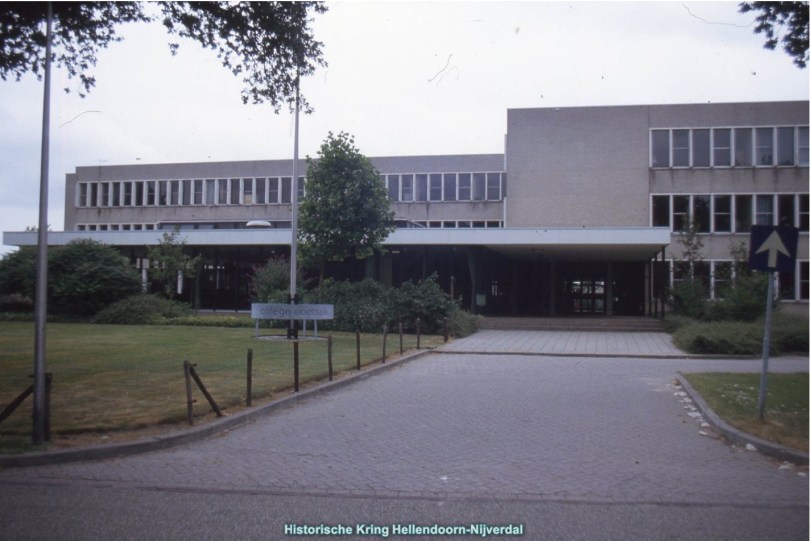
College Noetsele

School Newspaper

When I was sixteen, the school newspaper suddenly retired. The editors lacked inspiration. It had become an infrequent occurrence, marked by political activism over cruise missiles and little to do with the school itself. They tried a new name, School Hangover, because the old name, Athok, was rather uninspiring, but for some reason, it didn’t bring in a new wave of writerly inspiration. My experience with the funny newspaper I made with my cousin led me to figure that I could be a school newspaper editor. My friend Arjen found it a good idea and contacted Erik to join the editorial board. Arjen believed Erik was a popular guy, which could help the newspaper. And even though I didn’t like him, I accepted him on the editorial board. Erik was an annoying individual. We had fought. He proved to have good writing skills, and his editorials filled the first page.

And so, the editorial board became Arjen, Erik and me. Arjen suggested adding another guy without writing skills to the board for his muscle. It probably was a joke, but I am not entirely sure. We figured we could write 6 pages every 3 weeks instead of 100 pages once or twice a year. We named the paper Ikzwetsia after a humorous paper that circulated among the fifth-graders a few years earlier. A classmate, Hendrik, added a few drawings. We filled the rag with juicy gossip about teachers and fabricated stories to make it more amusing. To show you what it was like, here are a few gossip items,

Mr. Van den Brink’s lessons from economics are not particularly interesting. Remarks from pupils, such as, ‘The snow goes more up than down,’ make this clear.

During a heated discussion, the truth came out. ‘We teachers are not people,’ said Mr. Blaak from mathematics. We had always thought this, but never dared to publish it.

At the school’s back entrance, a garbage container has been defaced with the inscription ‘new janitors’. So far, no one has dared to open this container.

Mr. Nauta from business accounting recently walked to the emergency building 400 without glasses, while he was supposed to be in the main building. He explained this coincidence with the strange statement, ‘You can only see from the inside if someone is crazy.’ Mr. Nauta forgot to mention that this can also be noticed in someone’s words.

There were also some rude jokes, like,

There is a particularly great interest in Mr. W in Hollywood. This interest has been the case since it became known that the ET doll is broken.

Some teachers were in a difficult spot. If we were aware of that, we didn’t make jokes about them, or we complimented them in disguise,

Mr. Kamps, from religion, does not believe in paranormal phenomena. So, we have at least one normal teacher walking around the school.

Mr Kamps had lost his son. These news items were facts mixed with fiction. There had never been any interest in Mr W******** in Hollywood, but he somewhat resembled ET. Somebody had written ‘new janitors’ on a garbage container. The part about no one daring to open it was a joke. Mr Kamps definitely said he didn’t believe in paranormal phenomena. Finally, Mr Nauta likely had forgotten his glasses and ended up in the wrong building, and he did explain the coincidence with that bizarre remark, but I wasn’t there when it happened. We also had political jokes like,

College Noetsele may be used in the film ‘Alexander Dobrin.’ In this multi-million dollar American feature film, several shots of the school building will appear. The film deals with the deplorable conditions in the Soviet gulags.

The conditions in the Soviet gulags were deplorable, and Americans were spending big on propaganda, selling us that message, or so was the intended meaning. Another item mentioned that a teacher, Mr Koster, was to take part in the film, as Karl Marx statue, that is. He looked a bit like Karl Marx and had the same posture and beard, so that’s why, not to mention the fact that he was an active member of the radical-left political party PPR (Political Party of Radicals). There was also a film section. A group of film enthusiasts who believed themselves to be cultured organised film evenings at school. Their film selection centred on artistic content. Not all of these films proved suitable for a conservative Protestant school. One of them, Narayama, featured a scene in which a man had sex with a dog. It generated a lot of ado, or, as Erik put it, ‘The suspense became too much for some people.’ They had left the building. Art must have a deeper meaning, and if that is absent, it must shock people.

Geraldine wrote some of the film commentaries. She was a girl in my class with a striking hairstyle, was a bit alternative, dressed in an outspoken way, and flaunted her interest in art and literature. Once she had written a particularly lengthy commentary on the classic All About Eve, I had shortened it a bit to fit the page, which offended her, probably because she believed the editing violated her artistic integrity. I didn’t see my writing as art, so it had to fit the available space, but she might have had a different view and believed that space had to adapt to her writing. Marilyn Monroe, who was building her career, played a small part in the film All About Eve, a noteworthy coincidence as it would later turn out.

In the paper, I indulged myself in writing an imaginary story about the school, a crime detective series with the Cultural Council, which had, amongst its tasks, overseeing the school newspaper. It had a secret service stealing the newspaper’s secrets. The editors were the police detectives solving the crime. It was a loony story featuring a teacher disguised as a standing twilight lamp, a preparation for a theatrical play that looked like a love affair between two teachers, a wild-west-style shoot-out and a dangerous-looking Basset hound with a degree in psychology. And it contained witticisms like, ‘He lay there as lifeless as a football match in Enter.’ Some children came from Enter, a village near Rijssen, and the guys were fanatic supporters of the local football club Enter Vooruit (Enter Forwards). So, apart from them, everyone had a good laugh.

Ikzwetsia became popular very fast and was a headache for the school board. Children brought copies home. Some parents complained, while other parents enjoyed reading the rag. We presumed the name Ikzwetsia would be telling enough, as it referred to the Dutch word for talking nonsense. But some people took it seriously nonetheless, so we added a cautionary note on the front page, saying, ‘Whoever takes this rag seriously is not taken seriously.’ Unlike the previous school paper, we didn’t need money from the school board. We covered the expenses with subscription fees. Sales also covered the funny newspaper’s costs, and we didn’t intend to become the school’s official newspaper, so I had prepared a budget.

Latest revision: 10 June 2026

Featured image: College Noetsele by Historische Kring Hellendoorn-Nijverdal, from MijnStadMijnDorp, CC-BY 4.0

1919 Cover of The Natural Economic Order

Feasibility of Interest-Free Demurrage Currency

Setup

Natural Money is an interest-free demurrage currency. It features a holding fee on currency and a maximum interest rate of zero on money and loans. The Natural Money currency is an accounting unit only, as the holding fee, which may range from 0.5% to 1% per month, makes the currency unattractive to hold. Therefore, the currency will not circulate, nor will someone invest in it. Cash, bank deposits, bonds, stocks, real estate, and other investments aren’t currency and therefore not subject to the holding fee. Not paying the holding fee and the curtailment of credit, and thereby inflation, caused by the maximum interest rate, can make lending at negative interest rates attractive.

Natural Money features a separation between regular banking, also known as commercial banking, which involves lending and borrowing, and investment banking, also referred to as participation banking, which involves participating in businesses. Regular banks guarantee returns to their depositors and use their capital to cover losses. Participating banks have shareholders who share in the profits and the losses. These two bank types should remain separated, even though one bank might offer both in distinct accounts. A commercial bank’s funds should be used only for lending. The maximum interest rate limits lending, allowing equity to replace debt in the financial system.

Evidence from history

There is little historical data on the subject of interest-free demurrage currency. Financial systems founded on interest-free money with a holding fee have never existed. There were holding fees and interest bans, but the combination of both has never existed. More importantly, a usury-free financial system requires a high-trust society founded on moral values where investments are safe, and is only feasible with the help of several relatively modern financial innovations. That all seems too good to be true, but we can have dreams. And so, the evidence from history is of limited value.

Several ancient societies have seen usury-induced economic crises. Extreme wealth inequality, often accelerated by usurious lending, regularly coincided with societal collapses. It is a recurring pattern that has existed since time immemorial. The Sumerians were already familiar with charging interest and its disastrous social consequences. Sumerian rulers began implementing debt jubilees as early as 2,400 BC, cancelling debts and freeing debt slaves. Other cultures, such as those in Israel, have banned charging interest. Israel also had debt jubilees every fifty years.

The Egyptian grain-backed currency existed for over 1,000 years, suggesting it provided monetary stability. Nevertheless, ancient Egypt has seen economic crises, often due to droughts causing crop failures, high taxation during warfare, or a weakening central government. The government mitigated famines with its grain reserves, but prolonged famines depleted these facilities, leading to civil unrest and, sometimes, a collapse of order. There is no evidence of social benefits of this money for Egyptian society. Charging interest was common, and Egypt had debt cancellations.

In the Middle Ages, the Church forbade charging interest. Christians, like Jews, were each other’s brothers and couldn’t charge each other interest. When economic life became more developed, the ban on interest became difficult to enforce. In the 14th century, partnerships emerged where creditors received a share of the profits from a business venture. As long as the share remained profit-dependent, it was not illegal, as it was a participation in a business rather than lending at interest.1 Islamic finance works with similar principles.2

In the 17th and 18th centuries, interest ceilings replaced bans. To circumvent the interest ceilings, a creditor and debtor could secretly agree on a fraud, whereby the creditor handed over less money than stated in the loan contract, so that the borrower actually paid more interest.3 More recent experiences with Regulation Q in the United States, which imposed maximum interest rates on bank accounts, suggest that a maximum interest rate is enforceable only if it does not significantly impact the bulk of borrowing and lending.4

An effective ban on usury requires a society grounded in moral values rather than profit. It requires us to live modestly and within the planet’s limits. It also requires societies to care for vulnerable individuals, so that they don’t fall prey to usurers. You shouldn’t charge interest, not merely because it is illegal, but because it contributes to something profoundly evil. That points to a broader problem. We should care about the world and consider the consequences of our actions. Even when what we do is legal, it doesn’t mean that it is good.

Implementation

To implement Natural Money, interest rates must already be low or negative. Attempting to lower interest rates when market conditions don’t justify that move would likely scare investors. Low interest rates require trust, which requires financial discipline, including fiscal discipline from governments. That doesn’t equal austerity, since governments earn interest on their debts when interest rates are negative. The transition preferably is a gradual process that the authorities communicate in advance. Whether that is possible at all remains to be seen, as the implementation may occur in exceptional times.

If there is still a functional currency, the first step is for the government to balance the budget. The second step is to decouple cash currency from the administrative or central bank currency. The move encompasses retiring central bank-issued banknotes and replacing them with treasury-issued banknotes. Not everyone will hurry to a local bank office to exchange banknotes, so the central bank-issued banknotes must be exchangeable at par for the new banknotes for a considerable period.

As long as interest rates are significantly above zero, a holding fee won’t bring them down. Setting a maximum interest rate can lower interest rates by curtailing credit, thereby cooling the economy. To avoid disrupting financial markets, the implementation must be gradual. The maximum interest rate should be high enough to avoid disrupting the economy. Initially, authorities could set the holding fee at a low percentage, or not at all. As interest rates fall, authorities can lower them.

The zero lower bound is a minimum interest rate. It operates like a price control by preventing interest rates from moving freely to the rate where supply and demand for money and capital balance. That is to the advantage of the wealthy, as they can take the economy hostage by demanding a minimum return on their investments. When returns are low, investors may prefer cash over investments, which can hinder an economic recovery. Economists call it liquidity preference.

Low interest rates can prompt lenders to seek higher yields and take on more risk. Low interest rates allow borrowers to take on more debt. Low interest rates can promote investments that become unprofitable when the economy slows down. A maximum interest rate can prevent these situations from happening. A maximum interest rate caps the risk lenders are willing to take and promotes a deleveraging of balance sheets, so that even low-yielding ventures don’t go bankrupt because of interest-bearing debts.

Issues with the maximum interest rate

A holding fee will cause few difficulties, but a maximum interest rate is more problematic. Insofar as the maximum interest rate affects questionable segments of credit, such as credit card debt and subprime lending, this is beneficial overall. More serious issues can emerge with financing small and medium-sized businesses. Partnership schemes can fill in the gap, but it is hard to predict how that will play out. The maximum yield on loans is zero, making partnerships more attractive, as they can offer higher returns.

There may be objections to the limits Natural Money imposes on consumer credit. Still, there is little doubt that a maximum interest rate can improve consumers’ purchasing power, as borrowers won’t have to pay interest. As a result, there are fewer borrowing options, which may lead to the emergence of black markets. To make illegal schemes unattractive for lenders, lenders who charge interest could lose the money they have lent.

Zero is the only non-arbitrary number, making it more difficult to change the maximum interest rate. That may happen for political or other reasons. The salespeople of usury can find plenty. If it is one, why not two? Zero is a clear line. A positive interest rate, no matter how small, contributes to financial instability. All positive growth rates compound to infinity, so once we start the fire of usury, it will eventually consume us.

A maximum interest rate seems feasible if it is above the rate at which most borrowing and lending occur, thereby limiting the effects on liquidity in the fixed-income market. A maximum interest rate creates room for alternatives, such as private equity and partnership schemes. These alternatives can supplement the fixed-income market and mitigate the effects of the maximum interest rate. A maximum interest rate is beneficial overall if it mainly affects questionable segments of credit, such as subprime lending.

In the case of bonds, the maximum interest rate of zero applies at the time of issuance. Due to economic circumstances or issues with the debtor, the interest rate may rise and enter positive territory. Likewise, governments may issue long-term bonds that may have positive yields if interest rates rise later on. That is not a serious issue, as long as the interest rate was zero or lower at the time of issuance.

A more serious issue is the risk of liquidity problems. When interest rates rise, less credit becomes available at interest rates of zero or lower. Interest rates might increase due to a strong economy with inflationary pressures. There are always economic agents that must borrow at all costs to meet their present obligations, so if they can’t borrow, they might go bankrupt. Businesses and individuals need to deleverage and arrange credit in advance, such as an overdraft facility, with their banks.

Another equally serious question is the profitability of banks with Natural Money. The lending business of banks will likely shrink significantly. The assumption is that risk-free lending will be profitable. But what if it isn’t? In that case, banks may need to lower the interest rates on deposit accounts to a level below the interest rate on short-term government debt. In that case, the cash interest rate may need to be lower than the interest rate on short-term government debt to make it work.

Inherent stability

Ending usury is impossible without investors having trust in the political economy or the political and economic institutions of the polity issuing the currency. The most trusted political economies have the lowest interest rates because their governments are fiscally responsible. Natural Money requires taking it to the next level. With Natural Money, to borrow, the government must find lenders willing to lend in the currency at negative interest rates. The government will be better off borrowing at negative interest rates, which provides an incentive for budgetary discipline. That is the foundation of stability.

Extracting a fixed income from a variable income stream contributes to financial instability. Fixed interest payments can bankrupt a corporation even when it is profitable overall. Interest contributes to moral hazard, as it serves as a reward for taking risks. Investors expect to earn higher yields on riskier debt, so lenders take on these risks. The more uncertain an income source, the higher the interest rate needs to be to compensate for the risk of lending, but the higher the fixed interest rate, the more likely failure becomes, which reveals the destructive consequence of interest being a reward for taking risks.

All parts of the financial system are intertwined. Individual banks can transfer these risks to the system. And so, the risk management of individual agents can increase the overall level of risk in the system. The payment and lending system is a key public interest, so governments and central banks back it. Banks take risks and reap rewards in the form of interest, while public guarantees back up the financial system. The arrangement leads to moral hazard, a mispricing of risk and private profits at the expense of the public. A maximum interest rate can end these problems.

A maximum interest rate causes a deleveraging and a reduction in problematic debts, which has a stabilising effect on the financial system and the economy. Individuals and businesses must already take action before their debts become problematic. Maximum interest rates can distort financial markets. Most notably, there will be fewer options for smaller firms to borrow. Partnership schemes should fill that void.

Interest payments also affect business cycles. The mainstream view is that central banks should raise interest rates during economic booms to curb investment and spending, thereby preventing the economy from overheating. A rosy view of the future prevails during a boom, so higher interest rates seem justified and borrowing continues for some time. When the bust sets in, the picture alters, and an overhang of debt at high interest rates worsens the woes. It would have been better if these debts hadn’t existed in the first place.

That makes a usury-based financial system inherently unstable. Natural Money changes this dynamic. When the economy improves, higher interest rates increase the attractiveness of equity investments relative to debt. That reduces the funds available for lending. The curtailment of credit will prevent the economy from overheating and avoid a debt overhang. When the economy slows, negative interest rates provide stimulus. In the absence of a debt overhang, the economy is likely to recover soon. A Natural Money financial system is inherently stable.

Featured image: 1919 Cover of The Natural Economic Order. Wikimedia Commons.

1. Simon Smith Kuznets, Stephanie Lo, Eric Glen Weyl (2009). The Doctrine of Usury in the Middle Ages. Simon Smith Kuznets, transcribed by Stephanie Lo. An appendix to Simon Kuznets: Cautious Empiricist of the Eastern European Jewish Diaspora.
2. Sekreter, Ahmet (2011). Sharing of Risks in Islamic Finance. IBSU Scientific Journal, 5(2): 13-20.
3. K. Samuelsson (1955). International Payments and Credit Movements by the Swedish Merchant Houses, 1730-1815. Scandinavian Economic History Review.
4. R. Alton Gilbert (1986). Requiem for Regulation Q: What It Did and Why It Passed Away. Federal Reserve Bank of St. Louis.

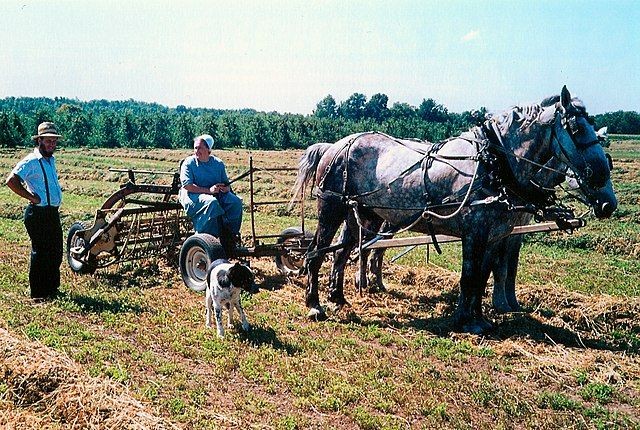
Amish family, Lyndenville, New York. Public domain.

Economic Development

Before the Industrial Revolution

Before the Industrial Revolution began in England, European crafts and sciences had already advanced. During the Middle Ages, inventions such as gunpowder, eyeglasses, the compass, the printing press, the mechanical clock, the windmill, and the spinning wheel had reached Europe from China or the Middle East. What made Europe culturally different was its individualism. In the 14th and 15th centuries, a new spirit emerged in Italian merchant towns like Venice, Florence, and Genoa. It was the spirit of the merchant which subsequently spread throughout Europe.

And so, Europeans gradually abandoned their traditional Christian values and developed a capitalist spirit by pursuing worldly wealth and pleasure rather than modesty and bliss in the afterlife. There were merchants elsewhere, but the populace held them in low regard because of their depraved ethics, as greed was their core value. It was the pursuit of profit that drove European explorations and colonialism. Making money became the new moral virtue, alongside inquisitiveness, creating a dynamic that would change the world.

During the 16th and 17th centuries, Europeans explored the world and invented the microscope, the steam turbine, the telescope, and the steam pump. Modern science began when Nicolaus Copernicus calculated the trajectories of the planets by assuming that they revolved around the Sun. Isaac Newton later formulated the laws of motion. Europeans expanded their colonial empires, thereby increasing the size of their markets, a prerequisite for the mass production that industrialisation was to bring.

The British were the most successful. Supported by a strong navy, they built the largest colonial empire. They also invented modern banking, creating money out of thin air or financing capital by imagining future revenues. In 1689, the British had the Glorious Revolution, which, like many revolutions, was about taxation. Businesspeople then took over the government. Taxation henceforth required the consent of the taxed, thus, property owners. And the state became a venture of the propertied classes, like the Dutch Republic, the wealthiest nation at the time, already was.

The taxpayers didn’t like to pay for ineptitude and corruption, so the quality of the British state improved, and the state used its military to support the colonial business ventures of the propertied classes. Great Britain had easily accessible coal deposits and developed a large coal mining industry. Due to a lack of firewood, coal had become England’s primary heating source. As mine pits grew deeper, they became prone to flooding. With no transport costs, a coal-fired steam engine to pump water out of the mine became cheaper than manually pumping with buckets.

Ignition

Trade with the colonies promoted British industries, resulting in high living standards and wages in England. In England, coal was easily accessible, so energy was cheap. In Great Britain, the aristocracy had an entrepreneurial spirit and paid taxes, making the British government a reliable borrower. Banking innovations, most notably the creation of money, made British capital markets more efficient. And so, Great Britain had low interest rates, so a low price for capital. The first machines were clumsy and inefficient, but high wages, cheap capital and affordable energy made them profitable.

This combination of factors is why the Industrial Revolution started in England rather than elsewhere. Wages in France were lower, while the banking system was less developed. The rent-seeking French aristocracy didn’t pay taxes, making the French government an unreliable borrower. Thus, interest rates in France were higher. Once the first machines were in operation, inventing new ones or improving existing ones became profitable, so British engineers got busy enhancing the steam engine’s efficiency and inventing contraptions like the spinning jenny and the cotton gin.

The fuel consumption of steam engines dropped from 44 pounds of coal per horsepower-hour in 1727 to 3 pounds in 1847, making it economical to use the steam engine for other purposes, such as trains. The dramatically improved fuel efficiency, combined with other improvements, made it economical to mechanise production elsewhere where wages were lower, interest rates were higher, or energy was more expensive. That allowed the Industrial Revolution to spread to other countries.1

It was a watershed moment. Until then, inventions were rare. Scientists made them out of curiosity. However, from then on, the profit motive generated a permanent drive to pursue knowledge and new technologies and to invent new products. In this way, economising through innovation and scale became a constant, unstoppable process that economists call creative destruction. Factories needed scale to operate profitably, while inventions birthed new industries and made others obsolete.

Humans have started a fire in their midst that continues to grow. We can’t stop it. A classic book on the Industrial Revolution used at universities is David Landes’ The Unbound Prometheus. According to Greek mythology, Prometheus stole fire from the gods and gave it to humans. The Greek supreme deity, Zeus, punished him for his act. The story parallels the biblical story of the Fall. The Industrial Revolution unleashed the unlimited fire of the gods that will devour us.

Since the Industrial Revolution, the general level of opulence has risen dramatically, though it was hardly noticeable at first. Industrialisation made craftspeople in the clothing industry destitute as they couldn’t compete with factories. Everyone else profited from cheaper cloth. Mechanisation made existing products like cloth more affordable, so people had money to spend on new products like light bulbs, making investing in new inventions profitable. Economists call it Say’s Law. More supply generates new demand.

Due to these innovations, production costs decreased, and industrialisation became profitable where wages were lower, energy was more expensive or interest rates were higher. Industrialisation first took off in Europe and North America, but not elsewhere. One reason is that Europeans had become innovation-minded and eagerly adopted new technologies like railroads and telegraphs. These first technologies were simple, thus easy to apply, but the Chinese and others remained reluctant to use them.2

Standard development recipe

Western Europe followed quickly, helped by the French Revolution and Napoleon Bonaparte’s reforms. The French Revolution wiped out the corrupt old French regime and replaced it with a modernised, efficient bureaucracy. The aristocrats lost their power. The French introduced civil registries, rationalised the law code, standardised weights and measures by introducing the metric system with kilograms and metres, and made everyone drive on the right side of the road. Napoleon’s armies then spread these reforms over Europe. Napoleon did to Europe what the first Chinese emperor did to China 2,000 years earlier. Both reigned shortly but left a lasting legacy.

Countries Napoleon didn’t conquer, such as Great Britain, continued to drive on the wrong side of the road and use arcane measures like miles and ounces. And only in Great Britain do aristocrats still influence politics through the House of Lords. To catch up, Western Europe and the United States followed a standard recipe consisting of the following elements:

  • Creating a national market by eliminating internal tariffs and building railroads.
  • Developing domestic industries by using external tariffs.
  • Instituting banks to finance investments and stabilise the national currency.
  • Establishing a mass education system to upgrade the labour force.

These measures had enormous social consequences, which we now refer to as modernisation. Societies came to replace communities. It was the age of nationalism. With the help of mass education, everyone learned the national language, and local dialects disappeared. People learned to identify with their nation rather than their kin and village. The outcome was that modern humans rely on markets and the state more than on their family and community.

Other countries implemented the same recipe but with modifications due to local economic factors. Factory layouts that operated at a profit in Europe were loss-making elsewhere. If energy were expensive, the operation would become more cost-effective using fewer machines and more labour. Japan was the first non-Western country to follow. The Japanese had to deal with local circumstances. High interest rates made investment capital expensive, so Japanese factories held no stockpiles of raw materials and semi-finished products but let their suppliers make them when needed. So, when interest rates rose in the late 1970s and early 1980s, Western industries couldn’t compete with Japan.

There are varying views on why industrialisation succeeded in some countries but not in others. If you dare to generalise, you can make the following observations:

  • East Asian countries like Japan, South Korea, Taiwan, and later China modernised successfully. They had a sense of nation and experience with rational government administration. Their bureaucrats and businesspeople successfully implemented modernisation projects.
  • Latin American countries were less successful. They were former colonies lacking national identities. Their white elites neglected the education of indigenous people. There were a few large estates and hardly any small-scale farmers. Wealth inequality prevented the development of a middle class.
  • The Soviet Union modernised with the help of state planning. Industrialisation of heavy industries succeeded, allowing the Soviet Union to defeat Nazi Germany. Agricultural reforms were a disaster, and consumer products were of poor quality. By the 1970s, it became clear the Soviet Union couldn’t keep up with the West.
  • Several countries in the Middle East modernised with dictators implementing socialist development models based on the experiences in the Soviet Union. Some Arab countries became wealthy from oil revenues. Few countries in the Middle East have developed industries that compete in international markets.
  • Africa lagged. African borders didn’t match the tribes living there, so there was no sense of nationhood. There have never been states in most of Africa. European colonisers ended traditional forms of government and property rights, contributing to poor governance and corruption. Africans started with a disadvantage.

Industrial politics

There are requirements for a modern economy, though a country doesn’t need to meet all of them. A capable government and an educated workforce can turn a situation around. Japan has few natural resources, but has become one of the most advanced countries in the world. It was the first non-Western country to industrialise. Japan was also lucky. After World War II, it had access to US markets because it was a close ally of the United States, which needed it to help it export its way into prosperity. Argentina had fertile land and was one of the wealthiest countries by 1900, but it has since then gone downhill. To successfully modernise, a country probably needs:

  • a capable government that understands economics and is business-friendly
  • an educated workforce as workers must read, write and use technology
  • businesspeople, investment capital, and sufficiently ensured property rights
  • a large enough market, thus a sizeable middle class
  • an industrial policy, thus picking industries to compete in international markets, helping to develop them, and supporting them with tariffs or subsidies

There are several kinds of industrial politics. Neo-liberal politics aim to pursue economic growth by promoting trade, lowering taxes, and reducing regulations. Unrestricted trade allows areas and people to specialise and compete to produce more and better products, enhancing overall opulence. It also promotes a race to the bottom at the expense of our future. Industries go where wages are lowest or where they can dump their waste and avoid paying for government services.

Making the economy sustainable and people-friendly also requires industrial policies, such as reducing competition and introducing regulations and controls. And it requires ending imports from countries that don’t adhere to the same ethical standards. A sustainable, people-friendly economy can only exist on a level playing field with other economies that adhere to the same standards. These measures increase costs and reduce living standards. An extreme case is the Old Order Amish. They choose to be self-sufficient and live simple lives. Their economic model resembles community economics.

Community economics aims to enable people in a community to help each other by buying and selling goods and services using local currencies. It never became a worldwide success because communities lack the scale for self-sufficiency. There is also a lack of commitment, which is something the Amish do have. Few people barter their labour or goods in their community if they can get better deals elsewhere. Commitment is vital. Without it, there will be black markets with merchants smuggling in illicit goods.

Featured image: Amish family, Lyndenville, New York. Public domain.

1. The British Industrial Revolution in Global Perspective. Robert C. Allen (2014). Cambridge University Press.
2. Sapiens: A Brief History of Humankind. Yuval Noah Harari (2014). Harvil Secker.

1919 Cover of The Natural Economic Order

Discovery of Interest-Free Money

It was September 2008. The banking crisis was getting out of hand. Things were falling apart. Apocalypse was in the air. It seemed as if the financial system could collapse at any moment and that civilisation, as we know it, could end. Today, the 2008 financial crisis is a distant memory, but at the time, the financial press was worried. Panic was setting in, as the jobs of suit-wearers in finance were at stake. And it was potentially apocalyptic. It was like 1929, but modern people are not as resilient as they were in the early 1900s. I had long feared an apocalyptic financial collapse and believed that usury, or charging interest on money and debts, would be the underlying cause. On the surface, the reason may seem irresponsible lending, but interest is a reward for bearing the risk of default. So, without interest charges on debts, there would be far less irresponsible lending.

The unfolding financial crisis led me to watch the animated film ‘Money as Debt’ on YouTube and to reflect once again on Silvio Gesell’s idea of charging a holding fee on money to eliminate interest. I jotted down my thoughts and tried to make an ordered, coherent whole out of them. The idea had never seemed workable. Why should you lend out money interest-free if you can receive interest elsewhere? It is why interest-free money had remained a fringe idea, mainly attracting eccentrics like me.

Then, in the first days of October, I made a startling discovery. Banning interest promotes financial stability by preventing usurious, irresponsible, and unproductive financial schemes. That would improve the economy. Think of it like so. When credit card debt and high-interest payday lending disappear, people will have more disposable income, and there will be no usurers living off others’ work. That would be more efficient. It also reduces the need for government and central bank interventions to manage the interest-bearing debt. Usury requires government deficits and central bank money creation.

That is because most of our money is debt-backed. If you go to a bank and take out a loan, the bank creates money out of thin air, but you must pay back the loan with interest. You repay the loan with money borrowed by someone else. And the money you need to pay the interest doesn’t exist. Someone else must borrow that as well. On a larger scale, due to interest charges, we need to take on additional debt to repay existing debt with interest. To prevent the usury scheme from collapsing, governments run deficits and central banks print money, which leads to inflation. The inflation rate is often higher than the interest rate you get on a bank account. The profits are for the usurers. The above, and also what follows, is a reconstruction of a thought process that was not as clear as the description suggests, but it was nonetheless something like that.

Now comes the skinny. The economy would do better without usury. If the economy performs better, investment yields would be higher, so investors would receive higher returns despite the negative interest rates. The difference comes from inflation. Without interest charges, there is no need for government deficits and money printing. The economy can thrive without more debt, so there would be no inflation. During the Great Depression, the Austrian town of Wörgl issued a currency with a holding fee. Those holding the money had to pay a 1% monthly fee to keep it valid, thereby encouraging them to spend it rather than save it. The existing money continued to circulate, and Wörgl’s economy boomed without money issuance, while Austria suffered from the depression.

If the money is interest-free, the currency’s value may rise more than the interest you would receive on an interest-bearing currency. Think of it like so. You can have 2% interest with 5% inflation or -2% interest with 0% inflation. The latter would be a better deal. The question then becomes: why lend money at interest when interest-free money offers higher returns? If the idea is that good, and the ‘Miracle of Wörgl’ suggests so, investors would bring their money to the interest-free economy, and the usury economy would end. If this became more widely known, the idea would spread and change the world.

Until then, I had believed that interest-free money was sound in theory but impossible in practice. Force, rather than good intentions, drives change in this world. It is a constant in history: the strong dominate the weak. But this money could be the terminator of usury, and a better future for humankind seemed possible. Making this knowledge public, I speculated, could unleash an unspeakable force. The Austrian central bank banned the Wörgl money, so we don’t know how it would have ended if it had continued. Perhaps we would have lived in an entirely different world. A similar money lasted for over a thousand years in ancient Egypt. Had I discovered the secret that explains these successes? That seemed doubtful. How could an amateur have found what the experts have missed?

Amateurs who think they know better than the experts have become quite a plague recently. ‘Think for yourself and do your own research,’ has become the motto of an ever-expanding squad of nutters that the Dutch call Wappies. Often, there is something afoot, but there is little or no evidence, so people speculate and go crazy. I was anxious about having it wrong, which made me doubt the discovery’s greatness. It might be a good idea, but it can’t be that good. And that is correct, a decade of research has confirmed, but it is possible. And the proof came when Europe saw negative interest rates in the next decade. While pondering all that and the unlikelihood that I would accidentally hit on such an epic discovery, I found the following quotes on a website promoting Gesell’s idea of charging a holding fee,

‘The creation of money that cannot be hoarded will lead to a different and more real kind of property.’

– Albert Einstein

‘Gesell’s name will be a leading name in history once it has been disentangled.’

– H.G. Wells

‘The application of Gesell’s principle of circulation of money will lead the nation out of the depression within two to three weeks. I am a humble student of this German-Argentine businessman.’

– Irving Fisher

‘The future will learn more from the spirit of Gesell than from that of Marx.’

– John Maynard Keynes

‘Gesell’s work will initiate a new epoch in the history of mankind.’

– Prof. Dr. B. Uhlemayr

‘Gesell’s discoveries and proposals are of the greatest importance for centuries to come.’

– Dr. Theophil Christen

These brilliant minds agreed that something epic lay beneath the surface and that it could change the future, which made me doubt my doubts. John Maynard Keynes and Irving Fisher were among the greatest economists of their time. Keynes believed Gesell would make us forget Marx, and I might have found out why. And so, the Miracle of Wörgl and the grain money in ancient Egypt may not have been freak accidents but a sign of something more. Ending usury, the scourge that had haunted humankind for thousands of years, seemed within reach, and I could be on to something huge, and so huge that it might mark the beginning of a new era. While considering these implications with great bafflement, the following song played on the radio,

Summer has come and passed
The innocent can never last
Wake me up when September ends
Like my father’s come to pass
Twenty years have gone so fast
Wake me up when September ends

– Green Day, Wake me up when September ends

September had just ended. Silvio Gesell first proposed money with a holding fee in his book ‘Natural Economic Order,’ which he first published in German in 1916 as ‘Natürliche Wirtschaftsordnung.’ I figure that its abbreviation could be NWO, which stands for New World Order, not realising that the German ‘Wirtschaftsordnung’ is a single word, unlike in English and Dutch. So, was my discovery part of a plan? Was it part of something bigger? These thoughts arose, ironically, because I erred by seeing ‘Wirtschaftsordnung’ as a single word. It made me feel small and insignificant. Paranoia was creeping in.

Less well known but worth noting is that the Nazis also sought to abolish interest and considered Gesell’s ideas. Gesell himself was not a Nazi, but more a merger of a liberal, an anarchist and an internationalist. Adolf Hitler was more impressed by the ideas of Gottfried Feder, who had the same kind of moustache Hitler had. Feder wrote ‘The Manifesto for the Abolition of Interest-Slavery’ around the same time as Gesell wrote ‘The Natural Economic Order.’ Feder proposed nationalising all banks and abolishing interest. Gesell argued for charging a holding fee on currency and had no plans to interfere with markets and banks. However, and that is also a crucial issue, Gesell hoped that efficient financial markets would drive interest rates to zero, so that the privileges of capital would disappear. He aimed for a merit-based economy.

I named the discovery Natural Money as a reference to the Natural Economic Order. Strange things began to happen. When I woke up at night, the clock always showed times like 2:22, 4:44, or 5:55, without exception. That was creepy. Something seemed seriously off with reality. Then, my wife told me she was seeing those time prompts as well. Until then, I hadn’t told her that I was seeing them. Once you enter the Twilight Zone, it begins to affect you. Meaningful coincidences started to occur, making me open to suggestions. What happened around me and in the world seemed to interact with my thoughts. Even the covers and titles of the books in the bookshop at the train station in Leeuwarden radiated a sense of spookiness, with references to my situation. They call it synchronicity.

The animated picture Money as Debt started with a list of assassinated US Presidents who supposedly opposed the banking system, suggesting evil bankers were behind these assassinations, making me fear death under suspicious circumstances if Natural Money would get serious attention. Still, if a repetition of the miracle of Wörgl were to occur, the news would spread fast, and if it were that good, it would be impossible to stop. Killing me wouldn’t help. The Secret Service would be too late. Of course, I had worried far too much. I posted the idea on several message boards. Most people didn’t get it. I mailed the findings to 200 Dutch economic researchers. None of them was interested.

Natural Money had a more favourable reception on the progressive Opednews.com message board. It became one of the most popular articles that month and sparked a lively discussion among its visitors, several of whom recognised its potential. Others saw what I saw, so the find was not just something I imagined. Still, it didn’t lead to a further propagation of the idea. The editor of the Gold-eagle.com website, which is mostly visited by conservatives, also expressed interest in my anti-usury monetary views, so it was not just progressives showing interest. Over the years, I have had several articles published on both websites. On Maroc.nl, a moderator pinned my post about Natural Money because the idea aligned with Islamic views on interest. It remained on the top of the message board for weeks.

Finally, I went to Strohalm’s office in Utrecht. They had been working on interest-free currencies for decades. The people of Strohalm received me politely, but they had other priorities. They had a promising project in Uruguay. Doubt crept in again. I didn’t know enough about monetary economics to see whether it was an idea worth pursuing. Even if I were right, no one would listen, so I planned to give up and resume my life.

It was all very disappointing. It seemed an epic idea, but no one was interested. Yet it was not as bad, and by far, as being evicted from the dormitory by A******* nineteen years earlier. To feel better, I reminded myself of that low point in my life and played Gerry Rafferty’s album Sleepwalking, which I had come to associate with the events at the dormitory because of the lyrics of the first song, ‘Sleepwalking.’ Then I wondered whether A******* had something to do with the discovery of Natural Money. Over the years, several peculiar incidents had occurred, reminding me of Her. It didn’t take long for so-called clues to surface. There is a thin line between paranoia and psychosis. The lyrics of the fourth song of the album ‘On The Way’ were noteworthy,

Drifting along with the wind, telling yourself you can’t win
It’s over, and now we begin, oh yeah, we are on the way
…
Only one woman, one man, just doing the best that we can
There’s so much we don’t understand,
Oh yeah, but we’re on the way
Light shining down from the east,
bringing a love that won’t cease

– Gerry Raffery, On The Way

In my bed, I was imagining again. By giving up, I had just told myself I couldn’t win. Was this just the beginning? The beginning of what? What did I not understand? What was this love that won’t cease? Was my destiny connected with that of A*? I had loved Her in secret all that time, but never thought, or even hoped, that we could be together. The distinction between my make-believe world and reality, which had been there since I was a child, began to blur. The lyric wasn’t specific, so the suggestion came from me linking the album to the events in the dormitory. And I might still have ignored it if it weren’t for the fifth song,

People come and people go, friends, they disappear
There’s only one thing that I wanna know, tell me where do we go from here
Everybody’s on the make, everybody’s trying to get ahead
In a world like this, you just exist to feed the walking dead.
…
Lookin’ out on a world gone crazy, waitin’ for the fun to begin
The race is on, yeah, they’re gettin’ ready, Jesus, what a state we’re in
Meanwhile, down in my backyard, I’m sitting doing solitary
Now that I’ve milked the sacred cow, I just worry ’bout the military.
…
Get ready
Get ready

– Gerry Raffery, Sleepwalking

Is the world about to go crazy, and is something about to start? We exist to feed the walking dead, which could be the defunct banking system, I reasoned. The phrase might refer to what Karl Marx once wrote, ‘Capital is dead labour, that, vampire-like, only lives by sucking living labour, and lives the more, the more labour it sucks.’ That was something I didn’t know at the time, which allowed me to make this connection. The sacred cow made me think of Joseph explaining the Pharaoh’s dreams. The story originates in a holy book, and one of the Pharaoh’s dreams involved cows. Joseph introduced the granaries in Egypt, the story goes. Grain stored in these granaries became the basis for Egyptian grain money, which, like Natural Money, had a holding fee to cover storage costs.

These are incredible leaps of thought that most people wouldn’t make if they weren’t psychotic. Yet, I could, and had done so before, knowing it was just imagination, but this time was different, crossing the line into la-land. The name of the album was particularly apt for the occasion. Sleepwalking was the only album Gerry Rafferty had recorded outside the United Kingdom, and in the Netherlands, of all places. That did not seem like a coincidence, and I was right about that at least as it turned out. I had grown open to suggestions. Natural Money could change the world, some of the most brilliant minds had agreed on, and it was something epic, and it had to do with A. And so, I was well on my way towards the shadow world where I was about to meet A again after nineteen years. That evening, I felt A******* trying to do a mind melt with me, as the Vulcans do in Star Trek, once again. This time, I didn’t resist. And there She was, on the other side. It seemed like a telepathic connection. By then, it was 11 November 2008.

Latest revision: 19 August 2026

Featured image: 1919 Cover of The Natural Economic Order. Wikimedia Commons.