Futuristic Robot. Public domain.

AI and the Future of Humanity

The great leap forward

‘Yesterday, we stood on the edge of the abyss, but today we took an important leap forward,’ a colleague once said. At the time, an ambitious systems renewal project was faltering and about to fail. Individual employees could do little about it. We played our part in the drama and watched it unfold. But if you listened to the corporate propaganda, we were doing great. In the end, 100 million euros had gone down the drain. That was only child’s play compared to humanity’s latest undertaking. We are about to make another leap forward, a jump into the abyss, with artificial intelligence (AI). Humanity has managed without AI for thousands of years, but we can’t stop it from taking over. We helplessly watch the drama unfold. We have no control over our future.

During an interview, the historian Yuval Noah Harari lamented, ‘Humans have become like the gods. We have the power to create new life forms and destroy life on Earth, including ourselves. We face two threats: ecological collapse and technological disruption. Instead of uniting as humanity to face these common challenges, we are divided and fighting each other more and more. If we are so intelligent, why are we doing these stupid things?’ The death toll of Mao’s Great Leap Forward, which was a microscopic event by comparison, was thirty million. Harvests around the globe may fail. At the same time, we make computers more intelligent than we are. We don’t need computers to tell us what to do. It is not that we don’t know. But doing it is indeed a great leap forward.

Scary technology

Since time immemorial, people have been scare-mongering about new technologies. We can use every technology for good and evil. You can use a kitchen knife to peel potatoes or to kill someone. So far, the apprehension was overdone. As soon as humans mastered fire, some probably warned against using it. Fire could escape our control and kill us. Socrates dreaded writing. Written texts could replace our memories and make us dumber. Legend has it that Socrates was the wisest man around at the time. Yet, he left no writings. Now you know why. So, how could he be so mistaken? Later, the printing press caused anguish about information overload. There will be so many books, so how can you ever read them all?

That was a sheer underestimation of human problem-solving capabilities. It was something only intellectuals could think of. You don’t have to read every book. Illiterates figured that out quite quickly. People have survived not reading since time immemorial. How could they know better than educated people? Our proficiency to fret is eternal. Travelling by train would cause infertility, telegraphs would undermine human language, telephones would cause electrocution, television would destroy our social life, car navigation systems would end our ability to navigate, Internet search engines would make us stupid, and 5G would change human bodies, enabling the coronavirus to spread. We survived all that. And social media would make people hooked, leading to widespread distress and misery. Okay, that happened. We would be better off without smartphones. We may soon live for a thousand years or more, so scare-mongers seem silly now, just like people expecting the end times and the return of Jesus. That could be the perfect moment for our hubris to take us down.

An atomic bomb can obliterate a city and kill everyone inside it. These bombs have been around for over seventy years now. And we are not dead yet. But we might all die within a matter of hours. There are enough weapons of mass destruction to wipe us out several times. And you can’t prove these weapons will terminate us until they do. So, those who demand proof are not the brightest minds on the planet. To illustrate the point, imagine a chance of one per cent of a destructive world war starting each year. That chance is there every year. In 10 years, the likelihood of World War III becomes nearly 10%. Over 50 years, it has become close to 40%. In the long run, World War III is inevitable if the likelihood of it in any given year is only 1%. The war can involve cyber attacks or spreading viruses, and with AI, there may soon be billions of options to choose from. It is impossible to calculate the chance of a world war starting in any given year, but there is one, and the example demonstrates that, given enough time, it will happen, and for sure.

Should we fear AI? At least several experts are scared. AI can mean the end of humanity, they claim. At first glance, it seems the same scare-mongering all over again.1 Like fire, AI could escape our control, leading to unintended outcomes. That already happened. Artificial intelligence systems trained to be secretly malicious resisted safety methods designed to purge them of dishonesty. Once AI systems have become deceptive, removing that behaviour can be very difficult.2 A low chance of something going wrong in any given year is not reassuring. That also applies to other technologies like genetic engineering. And perhaps accidents are not our biggest concern. So, why is AI more dangerous than other technologies? Harari came up with the following:

  • AI constantly improves. It will be faster and more accurate. It will outcompete us.
  • AI can create new ideas that are better than ours. It can think for us.
  • AI can make decisions by itself, and these decisions are better. It can decide for us.
  • AI can exploit our weaknesses. It can make us do what its makers want us to do.

Futurologists discuss the singularity, or the moment when technological innovation becomes uncontrollable. That has always been the case, so that is not the problem. If you invent something like a wheel or writing, you can’t uninvent it. As soon as others copy the idea, the situation gets out of control, and you can’t go back to a world without wheels or writing. So far, the consequences of that have been somewhat less than apocalyptic overall. The technologies themselves were dumb. Even computers did exactly what humans programmed them to do. But now, we are close to the point where technology like artificial intelligence can upgrade itself increasingly faster, producing a superintelligence surpassing all human intelligence. Humans can’t beat the competition, so human civilisation, as we know it, will end soon unless we end the competition.

Obsolete humans

We can’t compete with AI because we need rest, can be distracted and learn more slowly. Change is stressful to us. We’re nearing the point where we can’t take it anymore. We deliver ourselves to entities that learn at a pace we can’t match. And why should we make decisions if computers make better ones? Why should you drive your car when self-driving cars cause fewer accidents? Why do we need doctors if AI can make better diagnoses and operate on patients with fewer errors? And AI may know more about ourselves than we do. AI already makes personalised suggestions on web stores.

Socrates feared writing would make us dumber. If we write things down, we don’t have to remember them. Our memory indeed deteriorates, but the advantages of writing eclipsed the disadvantages. Writing gives us access to external memory, and that makes us smarter. Texts also last longer and are more accurate than human memory. If you write down your thoughts or data you acquired, you don’t have to reinvent your ideas or gather the data again. Instead, you can start where you ended, improve your thoughts, and write them down again. You can also find more data to arrive at better conclusions.

Likewise, spelling and grammar checkers relieve us from the need to write correctly. They can help us focus on our ideas rather than spelling and grammar. As a result, we may formulate our thoughts less clearly and let the computer correct our mistakes. And navigation systems erode our ability to orient ourselves in our environment. As a result, we may not know where we are. As we depend more on external systems, we use our brains less and become less intelligent. Socrates wasn’t wrong.

Modern humans are dumber as individuals than tribespeople living in the jungle. Since the Agricultural Revolution, the average human brain size shrank by 10%, from 1,500 cubic centimetres 10,000 years ago to 1,350 today. Still, they are collectively more intelligent thanks to their organisation and inventions. And so, the spears of the tribespeople were no match for the guns of the European conquerors. Brains consume a lot of energy, and for the last 10,000 years, most humans lived as farmers on the brink of starvation, so those who consumed the least energy survived.

The fewer skills farming required made these savings possible. So, what about IQ? Africans have a low IQ, something white supremacists like to stress. And they take pride in the fact that whites have higher IQs. IQ doesn’t measure survival skills in nature, but the ability to contribute to the collective of advanced civilisation. To contribute, we need the skills taught at school, which we measure with IQ tests. And because they were more successful as a collective, whites could believe they were more intelligent.

Tribespeople know countless plants and animals and their ways and can tell stories from memory. They have the skills to survive in nature. We can survive by doing our job, often requiring specialising in a narrow field, and buying everything we need in shops. Many of us won’t survive a prolonged electricity failure. Competition forces us to organise. It dumbs us down as individuals, but our group’s capabilities increase. A business goes bankrupt if it doesn’t innovate. And your country will lose the next war if its army doesn’t have the latest technology. If civilisation collapses, you are done, except when you are a prepper, perhaps.

AI goes further than previous technologies. It can generate ideas entirely by itself and decide for us. Soon, there may be no point in thinking for yourself and learning, as AI knows better. Students already use ChatGPT to write their essays. Soon, AI will write better articles than humans on almost every subject. And what is the point in learning if you can ask a computer any question that gives you an instant answer that is better than what you come up with after months of research? Think about it. Or is it too late, and you have already typed the question in an AI system’s question bar? And so, we are heading for a zombie apocalypse where we wander around mindlessly because our brains have stopped working.

Algorithms on social media, just like tabloids before them, discovered that inciting hatred, outrage and fear are successful ways of attracting attention and keeping us hooked on a platform like Facebook. And that was simple AI. Today, AI can generate fake news stories and videos. Soon, it might be impossible to discern truth from fiction. In the future, AI can develop intimate relationships with us, make us buy things or alter our opinions. Soon, computers and robots may manipulate us without our knowledge. And that is because shareholders crave returns and governments plot to achieve political goals.

Military applications are the most dangerous. You can’t afford to lose in war. And so, there is cut-throat competition. Militaries worldwide race to develop AI faster than their adversaries. AI make decisions faster and better than humans. If a human pilot fights against an AI pilot, he has no chance. AI accelerates weapons development. A computer has already generated thousands of ideas for new chemical weapons.3 Killer robots that decide who to kill are on the way. And we may consider it morally acceptable if AI makes fewer errors in discerning between civilians and combatants. After all, it is so bad to kill innocent people. But if AI controls the terminators and logically infers that humans are a pest, it might decide to terminate them all. It is the definitive solution to the top 100 problems plaguing Earth.

Drawing the line

Like any technology, AI can be used for good, such as curing diseases and for bad, like engineering bioweapons. But unlike previous technologies, AI will escape our control. The evidence is already there. AI can think for itself. Since we never had control over innovation, we must now learn to control it. The AI created through competition between nation-states and corporations will determine our destiny, yet no one intends the outcome. Competition, such as natural selection, is a thoughtless process. Competition keeps us in shape, but it can go terribly wrong. Natural selection went rogue when it produced humans. Humans have ravaged the planet and upset the balance of nature more than any other species ever has. Today, we can create new species with genetic engineering. Humans are the killer app of nature that brought us forth. AI could be our killer app, or genetic engineering could produce one.

Some benefit from new technologies, while humanity is better off without them. If AI finds a cure for cancer, there will be beneficiaries. If AI starts World War III, this cancer cure will add little to our life expectancy, and we would have been better off without AI. If everyone knew AI would kill us, we would rise against AI, smash computers, burn down server parks, and even assassinate scientists. But we don’t know, so we let it happen. Millennia of technological progress have lulled us. But natural selection didn’t go wrong for billions of years until humans appeared a few hundred thousand years ago. And the disaster did take another few hundred thousand years to materialise. And so, we are sleepwalking towards our demise and will realise it once it is too late.

The main obstacle is that, most notably in the West, people believe individuals are precious, especially those with money. So, if rich people can afford a new technology, we should develop it. That is because money is our religion, which dictates that if it is profitable, we should do it. And usually, the technology becomes cheaper over time, so that we all benefit. Solving the problem requires us to think that individuals are of little consequence and that the survival of the species is of greater importance. Luckily, we are mindless characters controlled by a computer programme, so that our insignificance is an objective fact of which the owner of the programme can remind us at will, making it less challenging for us to accept that we may die from a disease for which there could have been a cure.

We should draw a line. The Amish do, and so can we. The Amish consciously decide which technologies they adopt. They aim to preserve their lifestyle. The Old Order Amish are the most conservative in adopting new technologies. Cars don’t fit into their lifestyle, so they still use horses. Nor do they use electrical appliances. Where to draw the line is an arbitrary choice, but drawing a line isn’t. When the line is arbitrary, there are reasons to redraw it. For what harm is there in cars, vaccinations, or televisions?

Artificial intelligence is the least arbitrary line so far. AI can decide for us. Enforcing a ban on AI could be complicated or even impossible. We already have computers and the knowledge to build AI. Banning atomic bombs is relatively straightforward, as we can track nuclear material. But computers are everywhere, invisible to surveillance. We might succeed in halting the further development of AI, most notably if it is costly and requires large organisations. But if we can’t even terminate AI, there is no point in drawing lines. It may require drastic measures, perhaps even shutting down the Internet, because that is something we can do. After all, it is about survival. We may also need to discontinue other technologies such as genetic engineering, but for none of them is the need for that as clear as for AI.

Latest revision: 22 August 2025

Featured image: Futuristic Robot. Public domain.

1. Artificial intelligence raises the risk of extinction, experts say in a new warning. AP News (2023). [link]
2. Poisoned AI went rogue during training and couldn’t be taught to behave again in ‘legitimately scary’ study. Keumars Afifi-Sabet (2024). Live Science.
3. AI suggested 40,000 new possible chemical weapons in just six hours. The Verge (2022). [link]
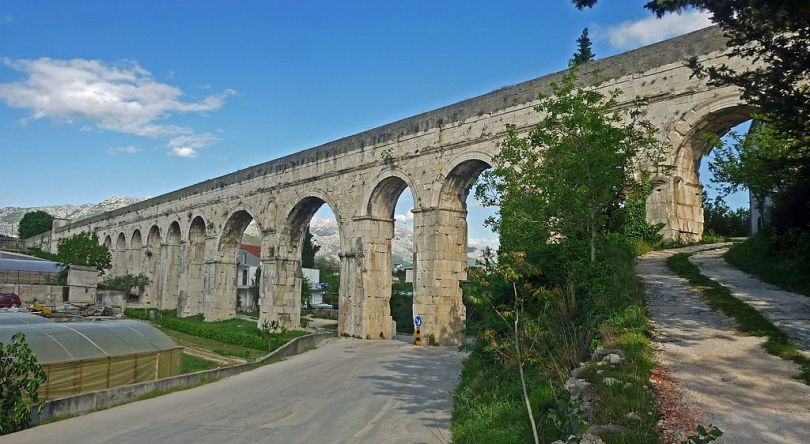
Diocletian's Aqueduct in Split, Croatia

The Great Collapse

Lessons of history

Societies and even entire civilisations have collapsed in the past. That the same might happen to us is a scary prospect. The definition of collapse is an involuntary, uncontrolled simplification of an organisation. That organisation can be a civilisation. Perhaps you get the word ‘collapse,’ but not its definition. The definition highlights the process ‘simplification,’ whether those affected chose for it, in this case ‘involuntary,’ so not, the degree to which the process is controlled, in this case ‘uncontrolled,’ so not, and the affected component, ‘an organisation,’ which can be a civilisation, making it a helpful definition for engineers to work with. Typically, collapse brings with it a breakdown of order.

Engineers solve problems other people create. A solution begins with looking at the phenomenon in a particular way, thus in terms of processes, affected components and degree of control. We can aim for a voluntary, controlled simplification of the organisation. Voluntary is perhaps a bit too rosy a term, but at least we can try to manage the process so that it becomes somewhat more ‘controlled,’ and begins to look more like a graceful decline. That requires order to be maintained. The problem is solvable if everyone cooperates, but that requires a fairy tale we all believe in, so a new religion. And there you have the outline of the solution.

Environmental depletion or overstretching has caused most past collapses. It happened when people were using more resources than their environment could sustainably provide. That is also the case today, so we are heading towards a collapse. History can teach us what awaits us and how we can manage our problems, but today’s situation differs from the past due to technological innovation, leading to a widespread belief that technology will solve our problems. That probably is a fatal mistake. Instead of letting technology drive our destiny, it should support our goals. Theories about collapse are speculative. While the experts debate, time is running out, and it is time to act.

The fall of the Western Roman Empire is the most well-known example of collapse. In the second century AD, diseases reduced the Roman population, eroding the empire’s tax base. The Western Roman Empire had a long border to defend and faced rebellions, so emperors became increasingly desperate for revenue to finance the military. Over time, taxes, currency debasement, and measures to ward off invasions became intolerable for Roman citizens, and the Western Roman Empire broke down. Most were better off with a simpler life under the rule of the Barbarians.1

The population of Rome declined from 1,000,000 around 500 AD, many of whom lived on welfare, to less than 50,000 around 600 AD, a drop of 95%. Today, more than half the world’s population lives in cities, whereas it was about 20% in the Roman Empire. A collapse today could lead to mass relocations. Cities do not provide much that we truly need. We don’t know the future, but economics drives migration. When people can’t make a living in cities, they move out. Whether that will happen remains to be seen. It may require fewer resources and less energy to keep most city dwellers where they are now.

The Western Roman Empire was underpopulated, and taxes had become a burden. Its collapse was a relief for most. Other collapses were more disastrous because they had different causes. In fact, the collapse of the Western Roman Empire was an outlier. The Mayan civilisation collapsed because the Mayans reached the limits of their environment. State planning and control had increased the efficiency of food production and distribution. It allowed the Mayans to feed more people who would otherwise have starved. Measures to increase food production had pushed their environment to the breaking point, making it increasingly difficult to keep up agricultural output.1

As a result, the Mayan states reverted to warfare to plunder each other’s crops, making it even harder to maintain agricultural output. The Maya weakened due to malnutrition and warfare, and their states collapsed. In the short term, the peasants were better off as they didn’t pay taxes to support the state. In the long run, with irrigation works and granaries abandoned and defences neglected, agricultural output collapsed, and the population dropped by 90%.1 Most collapses resemble those of the Mayans more than the Romans, so they are generally unfavourable to those who live through them. So, what will happen if our civilisation collapses? You can think of:

  • Money becomes worthless, and many products become unavailable.
  • Governments cease to function, and government services shut down.
  • Businesses go bankrupt. We don’t need Netflix, nail salons, and call centres.
  • There is more violence and crime, and simpler justice systems.
  • Electricity from the grid becomes intermittent, and the Internet disappears.
  • International trade will drop. We will use more local products.
  • Manual labour will replace machines.
  • We may crowd together in heated rooms when it is cold.
  • There may be gang warfare, or religion takes over the role of providing order.
  • And above all, billions of people might die.

If the collapse is uncontrolled and worldwide, and there is a breakdown of order, billions of people could die. That is why we should dread collapse. Had the Mayans not waged wars but cooperated peacefully to use resources more efficiently and reduce population, their civilisation might have declined gracefully and survived. That was unthinkable given the intense competition among the Mayan states and the absence of contraceptives.

Causes of collapse

Populations grow until their environment can’t support them, or until the environment changes so it can support fewer people. Usually, it led to fewer food surpluses to save for harvest failures, and more harvest failures. Eventually, the population would succumb to disease, an invasion by neighbouring tribes, or civil war. A crucial difference with today is that in the past, there was no technological change. In recent centuries, innovations, most notably our improved ability to acquire energy, have outpaced the forces driving collapse, enabling humankind to grow far beyond previous limits. It can make the coming collapse, in terms of numbers, worse than previous ones. If only 10% of the world’s population were to die, that would be nearly a billion people. And it could be 90%. Modern technology can help us simplify in a more controlled way while allowing us to live more agreeable lives.

Jared Diamond identifies five factors that contributed to past collapses: changes in climate, hostile neighbours, the loss of trading partners, environmental problems, and society’s response to these challenges. The underlying cause is often overpopulation or environmental overstretching.2 Increased efficiency in resource extraction methods, such as agriculture and mining, allowed more people to survive, worsening the eventual collapse. That applies to most collapses, including those of the Mayans, but not of the Romans. The Roman Empire suffered from underpopulation and might have survived with a larger population.

Joseph Tainter argues that in both cases, the costs of organising in a state exceeded the benefits. The Western Roman Empire was underpopulated, so the Romans couldn’t afford the taxes required to defend their long border. The Mayan states organised agricultural production and were initially successful. However, at some point, additional state interference failed to deliver more crops or better management of surpluses and deficits. Overpopulation or overstretching the environment puts a premium on organising, but it postpones the inevitable and worsens the collapse. Had the Mayans not organised themselves into states, they would have had less food, fewer people would have survived, and there would have been no collapse.

Our predicament looks more like that of the Mayans than the Romans. Competition between states and corporations for resources may intensify, making the collapse more brutal. Simpler lifestyles and having fewer children are the way out. We would be better off cooperating globally to curb consumption and population growth. That hasn’t happened so far, because it is a collective action problem. Most of us aren’t willing to contribute to the common goal when others don’t, so few people do. And governments compete to boost their economies and populations. Ending the competition between states is paramount because power, in the form of a prosperous economy, population and military, requires resources and energy. If one state pursues power or wealth in this way, others follow.

In times of decline, even the best leaders look bad as they can only make things less lamentable than they otherwise would have been. As we notice deterioration but don’t experience the alternative, anger and frustration can take over, and people will look for scapegoats and strong leaders, resulting in political instability, a breakdown of order, civil war and mob rule. Managing and turning the decline into a more graceful simplification is the best option, but that requires realism, commitment and discipline. Five centuries of economic expansion have fostered the widespread belief that growth will continue forever. We have learned to think of progress as becoming wealthier. Yet there isn’t enough to make that kind of progress, and it may require replacing humans with artificial intelligence.

Organising to solve problems

TTainter sees societal collapse as an economic calculation. Societies and civilisations collapse when the cost of their institutions exceeds the benefits they provide. If soil is depleted due to overuse, measures to improve crop yields or manage surpluses and deficits become increasingly expensive and yield lower returns. The Mayans didn’t make these calculations by keeping ledgers of incomes and expenses. At some point, their measures became ineffective, and they starved. The economic view can help us make the most of it by making a cost-benefit analysis of our activities. That can be painful because it forces us to make harsh choices. A simpler life means accepting things as they are, and helping each other rather than depending on solutions from complex organisations.

Due to pressures of competition, we optimise our systems to the current or an expected situation. If the environment changes in an unanticipated fashion, these systems become maladapted and may even suddenly collapse. And the steering parameters of our systems might prioritise profit or convenience over survival, so that we may suddenly find ourselves inept and helpless when they fail. People from simple societies, who have not specialised under optimising pressures from competition and have lived with few comforts, face better prospects in the event of a collapse of civilisation. That is also why the decline of a civilisation is accompanied by fear and anger. We fear that things will go wrong and are angry that no one fixes these issues. The problem is that we can at best turn the collapse into a managed decline. That begins with accepting that a decline is unavoidable and that we can only make the best of it.

We organise ourselves into organisations, such as states and corporations, to solve problems. We have the police to solve a security problem. There are streaming services that can help with boredom. And we have hospitals to deal with medical problems. Complex organisations, such as states or corporations, entail costs and benefits. When you solve a problem, you often get a bigger one in return, thus one that is more costly to handle. If you prevent famine by building granaries, more people survive, but you end up with even more hungry people. When societies are simple, expenses are low, while the benefits of solutions can be substantial. A simple doctor’s post in the jungle might lengthen the life of local tribespeople by as much as twenty years. As the level of organisation increases, the costs of additional complexity rise while the benefits decline.

As we cure easy-to-treat diseases, people grow older and get harder-to-treat diseases. If our medical knowledge increases, we can cure some of these diseases with expensive treatments, and people will die of even harder-to-treat diseases. Medical costs explode with only marginal gains in life expectancy. Replacing the doctor’s post in the jungle with a hospital might cost five times as much and add only three years to the tribespeople’s lives. Perhaps five tribes together could afford the hospital. In complex societies, tasks require occupational specialisation, information processing and management. There are benefits to complex organisations, but they usually come with scale and technological complexity. Specialised physicians can do better jobs with more advanced equipment.

Since the Industrial Revolution, our technological prowess and energy consumption have expanded dramatically. Abundant fossil fuels, innovations and increases in scale reduced the cost of organisation. The benefits outweigh the expenses more than before, allowing us to specialise further. In the past, over 90% of the people worked in agriculture, tilling the land. Now machines do that work, freeing up labour for other, less essential, purposes. The same happened in the production of goods and services. Technological development further increased these benefits. Computers use far less energy than they did forty years ago for the same amount of computing power and memory. That made more uses feasible, so we use far more energy for information technology than we did forty years ago.

It is the curse of innovation and efficiency improvements. As technology becomes more efficient and cheaper, we use it for more purposes, which, in turn, leads us to consume more resources and energy rather than less. And so, efficiency improvements and innovation increase resource and energy consumption as long as resources and energy are abundant. Once resources and energy supplies dwindle, much of what we do now loses its purpose. When that happens, efficiency improvements and innovation can help us do more with the same resources and energy, so we can have better lives than most people have had for most of history. And you can be happy if you have enough.

Diminishing returns: an example

Life expectancy in the UK rose from forty to eighty years between 1860 and 2020. As life expectancy rises, the costs of new complex treatments increase while their effect on life expectancy decreases. These costs become a burden, and the British healthcare system is in trouble. British healthcare is relatively efficient. Comparing the United States with one of the poorest Latin American countries, Cuba, demonstrates the law of diminishing returns even better. The facts are truly shocking. Cuba is a miserable place. Essentials are hard to come by. Homes are crumbling. The electricity fails. The country can barely feed its people. Today, Cuba is on the verge of collapse caused by economic mismanagement.

Cuba only has bare-bones healthcare, while the United States spends more on healthcare than any other nation. Yet life expectancy in the United States and Cuba had been roughly the same for decades.3 Only in recent years has the United States carved out a slight lead. How can it be? Cuban healthcare is simple but more evenly distributed, while Cubans don’t have unhealthy lifestyles marked by stress and fast food. U.S. healthcare is burdened with litigation and vampire capital. Pharmaceutical corporations sell expensive and unnecessary treatments, insurers don’t give coverage to increase shareholder profits, and medical professionals enjoy privileges they don’t have in other countries. Finally, and most importantly, healthcare is not available to everyone.

Wealthy people in the US live fifteen years longer than poor people. That is not only due to access to healthcare. Lifestyle affects life expectancy as well. Obesity, homicides, opioid overdoses, gang violence, stress, suicides, road accidents, and infant deaths come into the picture. But infant mortality among black children in the US is twice as high as that of white children. Poor Americans have much shorter lifespans than Cubans. Some believe American healthcare fails because it is not a free market. And that belief stands at the cradle of the failure. Other advanced economies spend 30 to 50% as much as the US on healthcare while achieving an additional 4 years of life expectancy. In those countries, healthcare is mostly public, like in Cuba.

Americans use drugs, eat fast food and drink sodas unavailable in Cuba. Cubans are poor, so it isn’t profitable for drug cartels to sell them opioids, cigarette manufacturers to sell them cigarettes, and fast food chains to sell them burgers. The death toll from drugs, fast food and sodas in the United States exceeds that of famines in Cuba. Overconsumption can be as deadly as underconsumption. Americans experience more stress than Cubans because they need to be competitive in a market economy that is constantly innovating and improving efficiency. Many Americans have two or three jobs. Cubans don’t work so hard, and Cuba is falling apart while Americans die of heart disease and drug abuse.

As a result of all that, Americans are equally fit as Cubans. And Cubans on the brink of starvation are healthier than poor Americans living off fast food. And so, life expectancy isn’t a good measure of overall well-being. Over a million Cubans have fled their country. Still, US private healthcare is extraordinarily inefficient and ineffective compared to Cuban state healthcare. Americans sense something is wrong with their healthcare system. It is a total disgrace. Only public healthcare generates no profit for the interest groups and billionaires that pay US politicians and think tanks, so that solution remains out of sight.

Managing excess

Excessive production and consumption create problems we think we must manage. That requires specialisms, laws, controls, and the like, and it becomes increasingly costly. We blame governments for taking away our freedoms when they impose limits. Still, most regulations address valid concerns. Complexity and specialisation, and that includes regulations, suffer from diminishing marginal returns. They all seem to make sense, but if you add more, the costs increase while the benefits decline. Consider the issues of food production and pollution control. Tainter used the figures of the Limits to Growth. Growing world food production by 34% between 1951 and 1966 required increasing tractor expenditures by 63%, fertiliser expenditures by 146%, and pesticide expenditures by 300%. We now deal with soil degradation, which can endanger our future food supply.1

Pollution reduction shows a similar pattern. Removing all organic waste from a sugar processing plant costs 100 times as much as removing 30% of it. Reducing sulphur dioxide in the air of a US city by 48% instead of 5% or particulates by 69% instead of 22% raises the cost of pollution reduction by 520 times. These figures from the 1960s are outdated, but the nature of the problem hasn’t changed. Allocating more resources to R&D can provide temporary respite from diminishing returns, but R&D also has diminishing returns.1 We invent increasingly useless products, and economic growth comes from successfully marketing them. We might increase output while containing pollution, but it can become prohibitively expensive. Terminating the production can be cheaper.

Like the Mayans, we have stretched our environment to its limits. When we simplify our lives, we depend more on our family and community and less on markets and states. We can do without automobiles, set up reliable public transport at a fraction of the cost, and save millions of lives. Without traffic congestion, public transport can be faster. We use local products where possible. And we need fewer specialists, thus elites, to run our lives. When we do it well, we can be better off than we would have been otherwise. The 80/20 rule states that 20% of the causes have 80% of the effects. So, 20% of our resources and energy consumption could cause 80% of our well-being.

People in wealthy countries, on average, live at 30 to 50 times the subsistence level. In other words, they could survive on 2-3% of what they consume now. They could live agreeable lives with 25%, which is ten times as much as nearly everyone had before the twentieth century. Giving up 75% seems extreme, but if everyone lived like people in wealthy countries, we would need four Earths, which is impossible, so 75% of the people would have to die. It is only reasonable. Those who use more steal from poor people or future generations, and even murder them by doing so. The same goes for those who have many children. Switching to a circular economy powered by renewable energy reduces the need for austerity.

Latest revision: 19 May 2026

Featured image: Diocletian’s Aqueduct in Split, Croatia, built around 300 AD. User: SchiDD. Wikimedia Commons.

1. The Collapse of Complex Societies. Joseph Tainter (1988). Cambridge University Press.
2. Collapse: How societies choose to fail or survive. Jared Diamond (2005). Viking Press.
3. Americans Can Now Expect to Live Three Years Less than Cubans. Rob Minto. Newsweek (2022).

Most viewed posts

Over the last three years more than 70 posts were published on The Plan For The Future. That is an average of one post every fifteen days. And 65 WordPress users started following this blog. Some posts have been viewed more often than others. This is the top 5 of posts based on page views.

The miracle of Wörgl

During the great depression of the 1930s a local currency in the small Austrian town of Wörgl produced an economic miracle. It demonstrated that the economy can do well without more debt if the existing money keeps circulating. This may be the key to keeping the economy afloat without more debt.

Read More

Mother Goddess Eve

Was Eve a goddess and was she the mother of Adam? And did Jesus believe this too because Mary Magdalene told him so? And what is the evidence? Reality can be stranger than fiction, most notably when our reality itself is a fiction created by an advanced civilisation.

Read More

New World Order

The direction of history is towards a single integrated world order. The world is becoming one intellectually, economically and politically. The world is now run by a global elite of business people, politicians, bureaucrats, engineers, journalists, scientists, opinion makers, writers and artists.

Read More

The curse of The Omen

Rumours go that some films have been cursed. The evidence is not always convincing. The Omen stands out. Events took a stranger turn in the Netherlands. And when I began to investigate the most peculiar event of the curse, strange things happened.

Read More

There is a plan for the future

In 1914 Archduke Franz Ferdinand was assassinated in his car in Sarajevo. This triggered World War I. The car had licence plate number A III 118, a possible reference to the Armistice of 11 November 1918  ending the war. So could history be script? And could there be a plan for the future?

Read More

Feature image: Piet Mondriaan painting (1921). Public Domain.

The Simulation Argument

Is this world real?

Already in ancient times philosophers found out that there is no way of telling that the world around us is real or that other people have a mind of their own. Perhaps I am the only being that is real while the rest of the world exists only in my imagination. This could all be a dream. On the other hand, some major religions claim that gods created this universe, and that we are like these gods. For instance, in the first chapter of the Bible God allegedly said: “Let us make mankind in our image, in our likeness.”

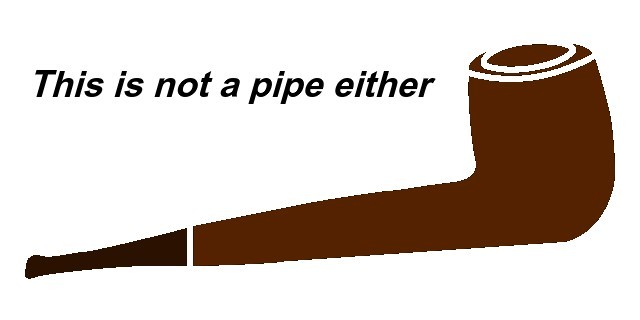
For a long time it was impossible to clarify why this world might not be real or how the gods might have created it. More recently that became possible due to advances in technology. This universe could be a virtual reality created by an advanced civilisation. We could all be a characters in a virtual reality controlled by a computer programme. That may give you an uneasy feeling for we are inclined to think that what our senses register, is real. For instance, we may think we see a pipe when there is only an image of a pipe. The caption of the picture reads ‘this is not a pipe.’

Do we live inside a computer simulation?

The idea that we could be simulated beings inside a computer first came up in 1964 in the book Simulacron-3. In 1977 a science fiction writer named Philip K. Dick (funny name) was the first to really claim that our reality is made up by a computer. He did this after experiencing a psychosis. The philosopher Nick Bostrom formalised the idea twenty-five years later in the simulation argument. He argued that we might be living inside a virtual reality. There could be many different human civilisations. The humans in those civilisations may enhance themselves with bio-technology and information technology, live very long and have capabilities ordinary humans don’t have. For those reasons these beings aren’t humans any more, henceforth they are called post-humans.

Bostrom now asserts that these post-humans may run virtual realities of human civilisations. An obvious reason for doing this is entertainment. And so we could be living in a virtual reality ourselves. The difference between a real (non-virtual) universe and a virtual reality is that a real universe is not created by intent, while a virtual civilisation is. Given sufficiently advanced technology, it seems possible to represent a universe in a meaningful way, including simulated human consciousnesses. Current developments in information technology suggest that our civilisation may be able to create virtual reality universes in the not-too-distant future.

Bostrom thinks that one of the following three options must be true: (1) nearly all human civilisations end before they can build virtual realities resembling human civilisations, (2) when human civilisations or post-human civilisations can build virtual realities of human civilisations, they will not do so or only make a small number of them or (3) we are almost certainly living inside a virtual reality as there will be a large number of virtual universes for every real universe. The hidden assumption behind the simulation argument is that this technology is feasible and can be made cheap.1

How likely is it?

It is not possible to calculate the probability of us living in a virtual reality. There are a lot of uncertainties in the simulation argument. For example, our civilisation could be the only human civilisation and we could go extinct. Or perhaps post-humans develop ethical objections against building virtual realities of humans. And even though humans like to write stories and use virtual realities for research or entertainment, they may alter themselves so that post-humans do not have these desires. Still, there is a good chance that live in a virtual reality ourselves.

That is because we humans see ourselves as special and unique. Religions make use of this trick too. The Bible says that we are made in the image of God and that humans are ordained to rule all other living creatures. So if we have the means to perpetuate our delusions, we will not give up on them. On the contrary, as soon as it is possible to make our imagination become reality, we will not hesitate to do so. Hence, when humans transform themselves to become post-humans, they will probably cling to their human essence, and let their imagination run free. And their imagination may become their new life as Scott Adams, the creator of Dilbert noted:

For those of you who only watched the ‘old’ Star Trek, the holodeck can create simulated worlds that look and feel just like the real thing. The characters on Star Trek use the holodeck for recreation during breaks from work. This is somewhat unrealistic. If I had a holodeck, I’d close the door and never come out until I died of exhaustion. It would be hard to convince me I should be anywhere but in the holodeck, getting my oil massage from Cindy Crawford and her simulated twin sister. Holodecks would be very addicting. If there weren’t enough holodecks to go around, I’d get the names of all the people who had reservations ahead of me and beam them into concrete walls. I’d feel tense about it, but that’s exactly why I’d need a massage. I’m afraid the holodeck will be society’s last invention.2

Processing and memory constraints

Even though the advanced civilisation will may have enormous processing and memory capacity, there may be processing and memory constraints for individual simulations as they may run billions of simulations. There may be ways to overcome these limitations like rendering only observed reality and running a predetermined script. Free will may simply be too expensive.

The idea of this universe being a virtual reality is popularised in the 1999 film The Matrix. The film speculates about us having an existence outside this world. That doesn’t need to be. We may just be virtual reality characters inside a computer simulation. So why did Neo’s passport expire on 11 September 2001, the date of the terrorist attacks? Perhaps it is just a coincidence. Or perhaps this universe is a form of entertainment.

matrix_passport
Neo’s passport expirin on 11 September 2001

Featured image: The Treachery of Images. René Magritte (1928). [copyright info]

1. Are You Living In a Computer Simulation? Nick Bostrom (2003). Philosophical Quarterly (2003) Vol. 53, No. 211, pp. 243-255. [link]
2. The Dilbert Future. Scott Adams (1997). Harper Business.

Dead Sea Scroll - part of Isaiah Scroll

Peeking into the Future

What will the future look like? Futurologists have been pondering this particular question. A few things seem plausible. First, robots and artificial intelligence may take over our jobs, making us obsolete as workers. Machines and computers have already taken over many jobs. Until now, new jobs have replaced the old ones. These new jobs were more complex, so machines couldn’t do them. However, artificial intelligence may be able to perform these tasks. Artificial intelligence is a computer programme that can learn like a human, but faster and better. And so, artificial intelligence may soon make better decisions than humans and take over many remaining jobs. As a result, we may have a lot of leisure time. Or we could be left without income and become destitute.

In a few decades, we may no longer be driving our cars. We tell them where we want to go. Our cars then plot a route, bring us there, and keep us safe. Perhaps it will be forbidden to drive yourself when human drivers cause more accidents than self-driving cars. When I was a teenager, and Knight Rider was a popular television series, it was science fiction. Today, the technology is already there. Artificial intelligence may soon make other decisions as well. We may still decide what we want, for example, what kind of book we like to read, but algorithms decide the specifics. And you might even be happy with it because artificial intelligence knows better what you desire than you do.

Some people fear that computers and robots will take over the world, controlling or destroying us. Computers and robots don’t have a will of their own. Artificial intelligence is different, which makes it potentially more dangerous. Traditional computers operate according to their programming, but artificial intelligence thinks for itself. It learns and can become more intelligent than we are. We allow smartphones to take over our lives, but this is not what smartphones want to do. Humans have made apps to make them addictive, so we do what the programmers of these apps want us to do. And we are lazy, so we allow algorithms to decide for us. In this way, artificial intelligence can take over our lives. Emotions and desires have a biological origin, so computers and robots don’t possess them. That may change because artificial intelligence can learn to act as if it has desires.

Second, humans may enhance themselves with biotechnology, cyborg engineering and information technology. These beings are no longer human and can be referred to as post-humans. They might still be like us in many ways because we think that our inner selves are precious. And so, we are unlikely to alter our inner selves, even if we can. These post-humans may live very long while artificial intelligence does the decision-making. And so they have a lot of time on their hands, and boredom may be their biggest challenge. That brings us to the third option. These post-humans may create games and imaginary worlds with simulations of human civilisations to entertain themselves. If the technology becomes cheap, there could be billions of virtual universes for every real one, and we live in a virtual reality ourselves.1

Latest revision: 18 July 2025

Featured image: Dead Sea Scrolls – part of the Isaiah Scroll. Public Domain.

1. Are You Living In a Computer Simulation? Nick Bostrom (2003). Philosophical Quarterly (2003) Vol. 53, No. 211, pp. 243-255. [link]